Argentina: Land of Broken Promises
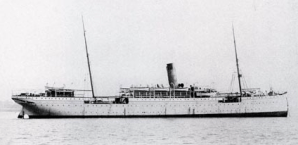
MV City of Dresden
The Argentine government of 1889, under Miguel Ángel Juárez Celman, actively encouraged immigration. It issued 50,000 free passages and its agents promoted Argentina all over Europe were more than ready to take their chances on foreign shores. Droves of immigrants were sailing west every day to the New World most to North America and a few to South America. The Irish immigration to Argentina began around 1825, peaked in 1848, and by the end of the century had petered down to a trickle as a result of the “Dresden Affair”.
The 1774 Irish immigrants who arrived in Buenos Aires on the M.V. City of Dresden on 16 February 1889, had less than little to celebrate on St. Patrick’s Day that year. The “Dresden affair”, as it was then called, became infamous and was denounced in Parliament, press and pulpit. Argentina, their “land of promise,” became the land of broken promises.
The City of Dresden carried the largest number of passengers ever to arrive in Argentina from any one destination on any one vessel. British immigrants and the Irish were British at the time were highly prized by governments as decent, hard working, God-fearing people who would improve their lot and their adopted land by the strength of their limbs and the sweat of their brows. The Argentine government agents in Ireland – Buckley O’Meara and John S. Dillon, a brother of the famous Canon Patrick Dillon who founded The Southern Cross made effective sales pitches for Argentina as “the finest region under the southern cross”.
It had taken Meara and Dillon more than two years to get 2,000 people together to fill the City of Dresden. The delay was caused by a press campaign conducted by influential Irish and Anglo-Argentines in Buenos Aires who knew perfectly well that the promises made by these two Argentine government agents in Ireland would not be fulfilled.
The City of Dresden, built in Glasgow in 1888 for Norddeutscher Lloyd as an immigrant ship, could carry 38 first-class, 20 second-class and 1,759 third-class passengers. On the voyage to Buenos Aires some passengers died at sea, probably due to lack of food and water.
Serious difficulties immediately arose when the ship docked in Buenos Aires. After nineteen days at sea, the passengers arrived undernourished and dehydrated. They had sailed from Cobh into a heat beyond their wildest imagination. The food and accommodation Meara and Dillon had promised them in Buenos Aires simply did not exist. The only lodging available, the Hotel de Inmigrantes, was, according to La Prensa, a “pigeon house in the Retiro”. It was known as the Rotonda and was located where the Mitre terminal of Retiro railway station is today. ( MUNTREF Museo de la inmigración is Hotel de Inmigrantes). The plight of the immigrants was compounded because Argentina was at that time going through a boom in immigration and up to 20,000 people were arriving at the port of Buenos Aires every month. The City of Dresden and the Duchesa di Genova carrying 1,000 Italians arrived on the same day. The incoming Irish who could not understand a word of Spanish or Italian, the linguas francas (a language used for communication between people who do not share a native language) on the teeming docks where husbands were separated from wives, children from parents, brothers and sisters from each other. Young single women and girls were sent to the Irish Convent on Tucuman Street. A lucky few of the immigrants found employment with rich families and landowners in the Irish and Anglo-Argentine community.
According to The Standard, a group of families were offered farm employment and were taken by train 200 miles into the province of Buenos Aires. At a railway station next-door to nowhere the train stopped in the middle of the night. The guide told the immigrants they had arrived, to get off and wait for him while he went to the farm to fetch transport. He never returned!
For its part the M.V. City of Dresden sailed the seven seas Europe and America north and south, Australia and the Far East, Suez and South Africa until it was sold to the Houston Line in 1903 and renamed “Helius“. In 1904 it went to the Union Castle Line and was laid up until Turkey purchased it in 1906 and renamed it “Tirimujghian” to sail the Black Sea where it was sunk by a Russian torpedo in the early days of World War 1.
The 1889 arrival of the SS Dresden represents the end of the Irish nineteenth-century emigration to Argentina. She ‘carried the largest number of passengers ever to arrive in Argentina from any one destination on any one vessel,’ and was the result of a deceitful immigration scheme managed by ‘the Argentine government agents in Ireland – J. O’Meara, and John S. Dillon, a brother of the famous Canon Patrick Dillon who founded The Southern Cross. [The affair] became infamous and was denounced in Parliament, press and pulpit ‘ [3]. These emigrants came from poor urban areas of Dublin and Limerick and most of the adults were city labourers and servants. After that, and up to the end of the 1910s, the Irish immigration was irrelevant. But in the 1920s, there was yet another peak of arrivals from Ireland (76% of 1900-1929 Ireland-born passengers arrived in the 20s), in which the majority of immigrants were educated urban professionals, with a higher proportion of Church of Ireland religion. This increase may have been a consequence of political, social, and economic turmoil in Ireland. However, it ended by the end of 1929, as a consequence of the global financial crisis that seriously affected the employment and economic growth of Argentina and other countries.
MUNTREF Museo WORLD
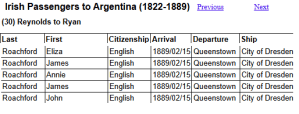
The Argentine Republic Emigration Scheme
On Friday 25th January 1889, the SS DRESDEN left the Deepwater Quay, Queenstown / Cobh, bound for Buenos Aires, with 1772 emigrants onboard 1500 of whom were Irish including the McCarthy family from Ballyclough, County Cork. The DRESDEN subsequently arrived in Buenos Aires on the 15th February 1889, and our family entered Argentina through the immigrants’ hotel located in Dársena Norte, Buenos Aires. The papers of the time reported of the appalling conditions that awaited the DRESDEN passengers on their arrival at the quayside of Dársena Norte, and but for the English speaking community of Buenos Aires moving quickly to resolve the problem of overcrowding, many would have died. On the afternoon of Tuesday the 26th February 1889, approximately ten days after their arrival in Argentina, a large number of the DRESDEN families were moved south to the new Irish colony set up by Peter Gartland, at La Vitícola, which was then located within the vicinity of Napostá, about 30km North of Bahia Blanca. Initially living conditions in the settlement were horrendous with little or no housing. Families were accommodated in tents with the majority living in the open and many of the youngest children became seriously ill. A lack of medicines along with their exposure to contaminated water resulted in numerous deaths among the most vulnerable immigrants. By early 1891 the Irish colony experiment at La Vitícola had failed disastrously, forcing our immigrants to abandon the camp en masse, leaving behind more than a hundred dead most of them Irish children buried in unknown graves and who now rest in eternal silence within the soil of Argentina.
.
 Cloud Surfman Travel